Your housing management system holds repair records. Your CRM tracks tenant communications. Your finance platform manages rent payments. But when a vulnerable resident reports an urgent damp problem, how quickly can your team see the full picture?
For many housing associations, essential information remains spread across separate systems. Connected tenant data brings together resident and property information into a trusted, accessible view, helping teams make informed decisions, respond more effectively and meet regulatory requirements.
Crimson helps housing associations build these connected data foundations using Microsoft technologies and responsible AI. In this guide, we explore what connected tenant data means in practice, why it matters for compliance and resident services, and how the right housing association AI and data consulting approach can support long-term transformation.
Key takeaways
- Connected tenant data gives authorised teams a trusted view of resident, property, repairs, complaints and finance information.
- Better access to accurate records supports safer, faster responses and stronger
- Housing associations should prioritise the data connections that have the greatest impact on resident safety, compliance and service delivery.
- Automation and AI can help teams identify risk, prioritise cases and reduce administration when supported by effective data governance and human oversight.
- Crimson combines housing-sector expertise with Microsoft technology to help housing associations connect data and improve resident outcomes.
What is connected tenant data and why does it matter?
Connected tenant data brings together relevant information about residents and properties from across housing management, CRM, repairs, assets, finance and communication systems. This gives authorised teams a clearer, more consistent view of each resident, tenancy and property.
When information remains spread across separate systems, colleagues may have to make decisions without full context. A housing officer responding to a complaint might not see previous repair requests for the same issue, while a customer service adviser may be unaware of a recorded vulnerability that makes a heating failure more urgent.
The cost of disconnected data
Housing associations often rely on several platforms to manage resident and property information. Each serves a purpose, but fragmented records can make it harder to:
- Identify residents or properties at increasing risk
- Follow a complaint from the initial report through to resolution
- Produce reliable regulatory reports without manual reconciliation
- Respond to urgent situations with the right resident and property context
- Give boards and operational leaders confidence in their decisions.
According to the Housing Associations' Charitable Trust (HACT), poor data quality and integrity remain a significant drain on the social housing sector, with an estimated 25–30% of resources spent recording, collating, cleaning and re-keying poor data. Improving data quality can release capacity for resident support, service improvement and earlier intervention.
Disconnected information is therefore more than a reporting problem. It can affect how confidently boards and operational teams assess risk, allocate resources and improve services. Read what housing associations are learning about data, confidence and decision-making.
How Awaab’s Law changes data requirements for housing associations
Awaab’s Law places defined requirements on social landlords to investigate and address hazards. Housing associations therefore need accurate, accessible information about residents, properties, previous reports, actions taken and any circumstances that may affect the level of risk.
What the regulations require
When a resident reports a potential hazard, teams need sufficient information to assess its severity, consider relevant household circumstances and vulnerabilities, investigate within the applicable timescale, communicate clearly and maintain an evidence trail.
That information may be recorded by housing officers, contact centre advisers, contractors, repairs teams and compliance colleagues. Connected tenant data brings it together into one operational view, helping authorised teams coordinate their response and act on the right information.
This will become increasingly important as Awaab’s Law expands to cover additional hazards. For more detail on the November 2026 expansion and the importance of connected repairs and vulnerability information, read Awaab’s Law Phase 2: Why Connected Data Matters More Than Ever.
What does a connected data foundation look like?
A connected data foundation for housing associations brings together three core capabilities: data integration, a unified tenant and property view, and operational automation. The aim is not to connect every piece of information, but to make trusted data available where it can improve a decision, service or resident outcome.
Data integration layer
The integration layer enables information to flow safely and consistently between housing management, CRM, repairs, asset management, finance and other resident-facing systems. This does not necessarily require housing associations to replace their existing social housing platforms.
Depending on the organisation’s technology landscape, Microsoft Dataverse and Azure data services can help bring information together and make it available through Dynamics 365 and Power Platform.
Unified tenant and property view
A unified view presents relevant resident and property information in one interface. When a resident contacts the organisation about a repair, an authorised colleague could see:
- Current tenancy details and household composition
- Recorded vulnerabilities and communication preferences
- Repair and inspection history for the property
- Previous complaints and their resolution status
- Relevant payment arrangements or service interactions.
Microsoft Dynamics 365 Customer Insights can combine information from multiple sources to support a more connected view. Explore Crimson’s social housing transformation approach.
Operational automation layer
Once information is connected and governed, housing compliance automation and intelligent workflows can help teams use it consistently. Examples include:
- Prioritising repair requests using hazard indicators and relevant vulnerability information
- Triggering alerts when complaint or repair histories suggest increasing risk
- Supporting the preparation of written summaries and resident communications
- Providing compliance dashboards showing investigation, action and communication timelines.
Power Automate can support these workflows alongside Dynamics 365 and other connected systems. Automation should be underpinned by clear accountability, appropriate access controls and human oversight.
How to identify and address data silos in your housing association
Most housing associations know that information is fragmented across different systems. The challenge is identifying where those disconnections have the greatest impact on resident safety, compliance and service delivery. A structured assessment can help prioritise the connections that will deliver the most value.
Map your data landscape
Start by documenting each system that holds relevant tenant or property information. For each system, record:
- What information it contains
- Who owns and maintains it
- Which integrations already exist
- How colleagues access and use the information
- Where data is duplicated, missing or manually re-entered.
This exercise can uncover inconsistent formats, duplicate records and manual workarounds. It may also reveal that important vulnerability or communication information is held outside core systems, making it harder for authorised teams to access and use consistently.
Identify high-impact integration points
Not every data silo presents the same level of risk or opportunity. Prioritise potential integrations by considering:
- Regulatory compliance: Which data gaps create the greatest risk for Awaab’s Law and Consumer Standards compliance?
- Resident safety: Where could missing information delay the identification or escalation of risk?
- Service effectiveness: Which manual processes consume time, create errors or require residents to repeat information?
- Strategic value: Which connections would create a reusable foundation for reporting, analytics and responsible AI?
For many housing associations, connecting repairs management and CRM should be an early consideration. Bringing together complaints, property conditions, repair histories and relevant resident circumstances can give teams better context when identifying and responding to potential risks.
“Connected data does not mean bringing every piece of information into one place for the sake of it. It means identifying the information your teams need to make better decisions, agreeing what good data looks like and making that information available at the point it can improve an outcome. That is what creates the foundation for stronger compliance, more proactive services and responsible AI.”
Ian Bobbett, Chief Data Officer, Crimson
Build a data governance framework
Connected tenant data requires clear governance. Without agreed definitions, ownership and controls, housing associations risk connecting inconsistent information rather than creating a trusted foundation for reporting, automation and AI.
Data standards and definitions
The UK Housing Data Standards, developed by HACT with input from more than 100 housing associations, provide a framework for organising data consistently. Using shared standards can also support collaboration with partners and contractors, as well as future system integrations.
Clear definitions are particularly important for:
- Vulnerability categories and recording protocols
- Property attributes and condition assessments
- Complaint and repair classifications
- Resident communication preferences and consent.
Data ownership and accountability
Named owners and data stewards should be responsible for the accuracy, completeness and appropriate use of priority information. This helps prevent data quality from declining because responsibility is unclear.
Governance should also reflect UK GDPR requirements, particularly when records include health, vulnerability or other sensitive information.
Quality monitoring and improvement
Data quality requires ongoing monitoring rather than a one-off clean-up. Housing associations should:
- Review priority fields for completeness and accuracy
- Use validation rules to identify potential quality issues
- Create feedback loops that correct problems in the originating process
- Monitor whether connected information is improving the intended operational outcome.
What role does AI play in connected tenant data?
AI can increase the value of connected tenant data by helping authorised teams prioritise cases, identify patterns and reduce administration. However, it depends on accurate, well-governed information and should begin with a clearly defined service, compliance or resident outcome, rather than the technology itself.
This relationship between outcomes, trusted data and governance was explored at Crimson’s Building an AI-ready housing association leadership exchange. Read AI in Social Housing: Why Trusted Data Matters More Than AI Tools.
Practical AI use cases for housing associations
Potential applications include:
- Case prioritisation: Analysing repair requests alongside relevant vulnerability information and property history to highlight cases requiring urgent attention
- Pattern recognition: Identifying complaint or repair patterns that may indicate an emerging hazard
- Predictive maintenance: Using repair histories and property characteristics to identify assets that may require intervention
- Document automation: Using Copilot capabilities to prepare draft summaries and resident communications for colleagues to review.
These use cases show why effective housing association AI and data consulting must consider data quality, governance, operational processes and adoption alongside the technology.
See connected housing data and AI in practice
Crimson’s on-demand demonstration explores how connected information can support complaint root-cause analysis, damp and mould case prioritisation, predictive repairs and compliance insight.
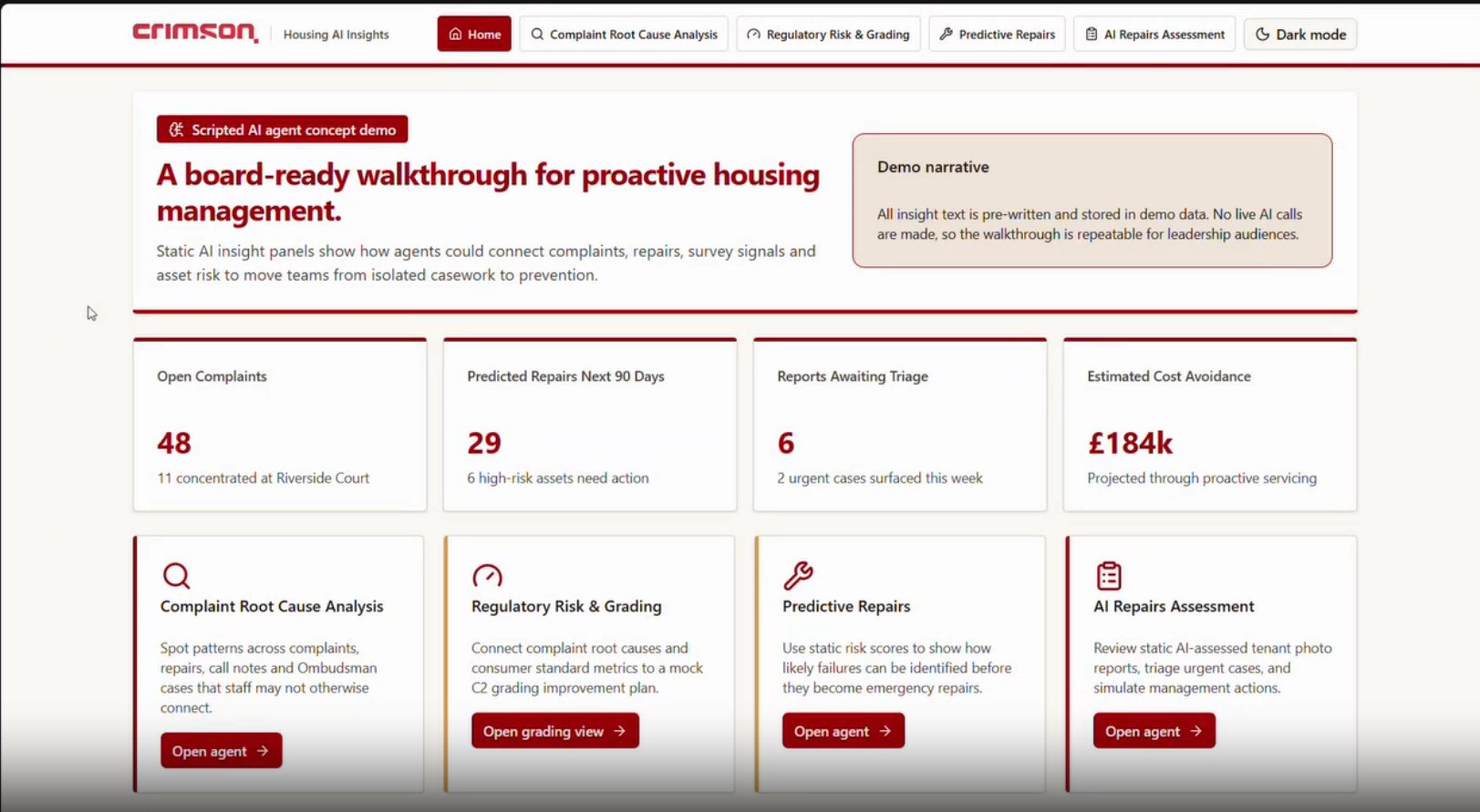
Watch AI in Social Housing: Improving Repairs, Complaints and Compliance.
Responsible AI principles
AI-supported processes in housing require particular care because decisions concerning prioritisation, vulnerability and resource allocation can affect resident safety and wellbeing. Responsible AI should include:
- Transparency about how recommendations are generated
- Human oversight, particularly where decisions affect vulnerable residents
- Regular monitoring for bias and unintended consequences
- Clear accountability for AI-supported decisions
- Appropriate data protection, permissions and security controls.
AI should support housing professionals, not replace human judgement where context, accountability and individual circumstances matter.
For a wider sector discussion about AI, data and automation, watch AI in Social Housing: A New Era of Human Potential for Housing Associations. You can also explore Crimson’s Housing Associations video playlists on YouTube.
How to plan your connected data journey
Building a connected data foundation is best approached in phases. The scope and pace will depend on your existing social housing platforms, data quality, governance and priority use cases. Rather than trying to connect every system at once, focus first on the information that can deliver the clearest improvement in compliance, resident safety or service delivery.
Phase 1: Foundation
- Agree the priority outcomes and identify the highest-risk information gaps
- Define the shared data and integration approach
- Connect priority sources, such as CRM, repairs, complaints and asset information
- Create an initial unified tenant and property view
- Establish data ownership, standards and controls.
Phase 2: Expansion
- Extend integration to other priority systems
- Introduce housing compliance automation and operational workflows
- Build dashboards to support operational and strategic decisions
- Enhance the unified view with additional trusted information.
Phase 3: Optimisation
- Introduce governed AI use cases for prioritisation and pattern recognition
- Develop predictive maintenance and proactive intervention capabilities
- Improve appropriate self-service and resident communication journeys
- Refine processes using operational insight and resident feedback.
What should you look for in a transformation partner?
A connected data programme requires more than technical capability. The right partner should understand your desired outcomes, the social housing operating environment and the governance and adoption needed to embed lasting change.
Housing-sector expertise
Look for experience of addressing data, compliance and service challenges within housing associations. A sector-informed partner should understand areas such as tenure, Tenant Satisfaction Measures and the Consumer Standards, helping teams move more quickly from requirements to practical solutions.
Ask prospective partners about the housing organisations they have supported, the challenges they have addressed and how they keep pace with developments such as Awaab’s Law.
Microsoft capability
If your organisation uses Microsoft technology, look for proven expertise across Dynamics 365, Power Platform and Azure data services, supported by relevant Microsoft Solutions Partner designations.
Crimson holds Microsoft Solutions Partner designations for Business Applications, Data & AI, and Digital & App Innovation, alongside experience of applying these technologies in the housing sector. Crimson is also recognised within Microsoft's AI Business Solutions Inner Circle, reflecting expertise in delivering Microsoft-based transformation programmes.
Support beyond implementation
Connected data programmes continue beyond go-live. Consider how a potential partner will support adoption, optimisation and future development as your services, data and regulatory requirements evolve.
A strong housing association AI and data consulting partner should combine sector knowledge, technical capability and long-term support, while keeping resident and operational outcomes at the centre of the programme.
How do you measure success?
The success of a connected tenant data programme should be measured against the compliance, service and resident outcomes it is intended to improve. Establish a baseline and agree a focused set of measures before delivery begins so you can assess whether connected information is making a meaningful difference.
Compliance measures
- Time from a hazard being reported to the start of an investigation
- Percentage of cases meeting applicable timescales, including those under Awaab’s Law
- Completeness and accuracy of relevant vulnerability records
- Accuracy and traceability of compliance reporting
Service and efficiency measures
- Time spent manually finding, checking and reconciling information
- Number of systems colleagues need to access for common tasks
- Time required to produce operational and regulatory reports
- First-contact resolution rates, where appropriate
Resident outcome measures
- Resident satisfaction with complaint and repair handling
- Time from initial report to resolution
- Levels of repeat complaints and repairs
- Evidence of earlier intervention in priority cases
Reviewing these measures throughout the programme can help housing associations understand what is working, identify where further improvements are needed and keep the focus on operational and resident outcomes.
Building data foundations that support better resident outcomes
Connected tenant data is not simply a technology project. It gives authorised teams the context to respond confidently, helps leaders understand risk and creates a foundation for stronger compliance, more proactive services and responsible AI.
Housing associations already hold valuable information across housing management, repairs, assets, complaints, finance and customer service systems. The priority is to identify where disconnections create the greatest risk and where bringing information together could deliver the clearest benefit for residents and services.
Crimson’s Housing Association Data Assessment helps organisations understand their current data landscape, identify priority integration opportunities and develop a practical roadmap for connected tenant data, housing compliance automation and responsible AI adoption.
Ready to turn disconnected housing data into practical action? Talk to Crimson about your housing data priorities.
FAQs about connected tenant data for housing associations
What is connected tenant data for housing associations?
Connected tenant data brings together relevant resident and property information from housing management, CRM, repairs, assets, finance and communication systems into an accessible, governed view. It gives authorised teams clearer context, supporting more informed decisions and consistent resident services.
How does connected data support Awaab’s Law compliance?
Connected data makes it easier for authorised teams to access repair histories, complaints, communications, property information and relevant vulnerability records together. This can support faster assessment, clear communication and a traceable record of the organisation’s response, alongside effective processes and controls.
What systems typically need to be connected?
Priorities vary, but housing associations commonly connect housing management, CRM, repairs, asset management, complaints, finance and resident communication systems. The best starting point is usually the connection that addresses the clearest compliance, safety or service need.
How long does connected tenant data take to implement?
There is no standard implementation timescale. It will depend on the number and condition of existing systems, data quality, governance, integration complexity and the outcomes in scope. A phased approach allows housing associations to prioritise high-value connections and deliver improvements incrementally.
What role does AI play in connected tenant data?
AI can help authorised teams prioritise cases, identify patterns, support predictive maintenance and prepare documentation for review. Its effectiveness depends on trusted data, clear governance, appropriate human oversight and a defined operational or resident outcome.
How do housing associations maintain data quality across connected systems?
Effective data governance establishes consistent definitions, ownership and monitoring. Practical measures include named data stewards, validation rules, regular reviews of priority information and feedback loops that address problems in the originating process.
What should housing associations look for in an AI and data consulting partner?
Look for a partner with housing-sector expertise, proven Microsoft platform capability and an approach that extends beyond initial implementation to adoption and optimisation. Effective housing association AI and data consulting should connect technology decisions to measurable compliance, service and resident outcomes.
Crimson combines housing-sector knowledge with expertise across Microsoft Dynamics 365, Power Platform and Azure data services, helping housing associations develop connected data foundations that support long-term transformation.
Read On