
Many organisations have experimented with artificial intelligence. Far fewer have built a clear enterprise AI strategy that allows them to scale AI across the organisation.
Over the past two years, AI pilots and proofs of concept have appeared across almost every industry. Teams test generative tools. Innovation groups explore automation opportunities. Leaders ask how AI could improve productivity or unlock new insights.
These early experiments are valuable. They create learning and momentum.
But moving from experimentation to enterprise adoption is where most organisations struggle. Scaling AI requires more than technology. It requires clear outcomes, strong governance, and an operating model that allows innovation to grow responsibly.
In this article, Oliver Sinclair, Chief Technology Officer at Crimson, explores why many AI initiatives stall and how organisations can build an enterprise AI strategy that turns early experimentation into real operational impact.
Watch the podcast for actionable insight beyond the headline themes.
Why Most AI Pilots Never Scale
Many organisations start their AI journey with genuine enthusiasm.
The board wants an AI strategy. Innovation teams are exploring new tools. Departments are keen to experiment with generative AI to improve their work.
However, these initiatives often begin with the technology rather than the outcome.
When organisations start with the idea that they need AI, the conversation quickly becomes about deploying tools rather than solving real operational problems. Without a clear objective, even successful pilots struggle to move beyond experimentation.
Organisations that succeed in scaling AI approach the challenge differently. They start by identifying a specific business problem and then explore how technology might help solve it.
Typical examples include:
• Reducing time spent on administrative work
• Improving access to organisational knowledge
• Delivering better insight for decision making
• Streamlining service delivery for customers or citizens.
Once the outcome is clear, it becomes easier to assess whether AI is the right solution and how to measure its value.
This is the foundation of a practical enterprise AI strategy.
What Scaling AI Across the Enterprise Really Means
Scaling AI is often misunderstood.
It does not mean running more pilots or deploying more tools. Enterprise adoption means embedding intelligence into the everyday operations of the organisation.
This shift usually affects three areas at once.
Mindset: transformation begins with people
Within every organisation, there are individuals who recognise inefficiencies and want to improve how work gets done. These people often become champions of change.
Successful organisations identify those champions early and involve them in shaping new solutions. When teams understand the purpose of AI and feel ownership of the outcome, adoption becomes much easier.
Without that cultural readiness, even powerful technology will struggle to deliver value.
Skills: A supportive mindset must be backed by capability
AI adoption introduces new areas of expertise that many organisations are still developing.
These include:
• AI governance and ethical oversight
• Data readiness and information security
• Testing approaches for non-deterministic systems
• Designing processes that incorporate AI support.
Very few organisations currently have all these capabilities internally. Many rely on specialist partners to help build these foundations while accelerating progress.
Technology: The final piece of the puzzle
Modern AI capabilities are increasingly embedded within platforms such as the Microsoft ecosystem. Solutions such as Dynamics 365, Power Platform, Copilot Studio, and Azure AI enable the integration of intelligence directly into everyday workflows.
However, technology alone will not deliver transformation.
Scaling AI successfully requires platforms, governance and culture to evolve together.
Why AI Initiatives Stall After the Pilot Stage
Even when a pilot works technically, organisations often struggle to expand it further.
Three common issues tend to appear:
Adoption was never designed
If an AI solution is created without involving the people who will actually use it, adoption quickly declines.
Users need to understand how the solution works, but more importantly, why it exists and how it improves their role. Generative AI also introduces new behaviours. Results may vary depending on how people interact with the system, which makes training and change management essential.
AI was applied to the wrong problem
AI is powerful, but it is not always the best solution.
Many challenges can be solved through automation, improved workflows, or better use of analytics. Treating AI as part of a broader transformation toolkit helps organisations focus on outcomes rather than technology alone.
AI was placed into a broken process
Introducing AI into an inefficient process rarely delivers the expected benefits.
If teams already struggle with fragmented systems or manual workarounds, adding AI into the process can increase complexity rather than reduce it.
Organisations that succeed in scaling AI often redesign processes alongside the introduction of AI capabilities.
The Governance Challenge in Scaling AI
As organisations move from proof of concept to production, governance becomes increasingly important.
Enterprise AI solutions must consider a range of factors, including:
• Data security and access control
• Privacy and regulatory compliance
• Responsible AI and ethical oversight
• Robust testing and resilience.
For example, organisations implementing tools such as Microsoft 365 Copilot often discover that their document environments need restructuring before they can implement the tools. Without clear access controls, AI tools could unintentionally surface sensitive information.
Watch the webinar: Fuel Copilot With Confidence: Stronger Data, Safer AI, Better Results
These governance considerations are not barriers to progress. They are essential safeguards that allow organisations to scale AI responsibly.
A well-defined enterprise AI strategy recognises these requirements early and plans for them.
Building an Operating Model for Enterprise AI
Organisations that succeed in scaling AI rarely rely on isolated experiments.
Instead, they develop a structured approach that turns business ideas into production-ready solutions.
This typically involves stages:
- First, teams identify a business challenge or opportunity
- Next, leaders assess the potential value of solving that challenge
- Governance teams review security, privacy and ethical considerations
- Technology teams design and test the solution
- Finally, change management ensures the solution is adopted successfully.
This structured approach allows organisations to innovate while maintaining control. Scaling AI becomes a repeatable capability rather than a series of disconnected pilots.
Designing an Enterprise AI Strategy in a Fast-Moving Landscape
One of the challenges organisations face is the pace of AI innovation. Capabilities that seemed experimental a year ago may now be ready for real deployment. Because of this, traditional technology roadmaps are often too rigid.
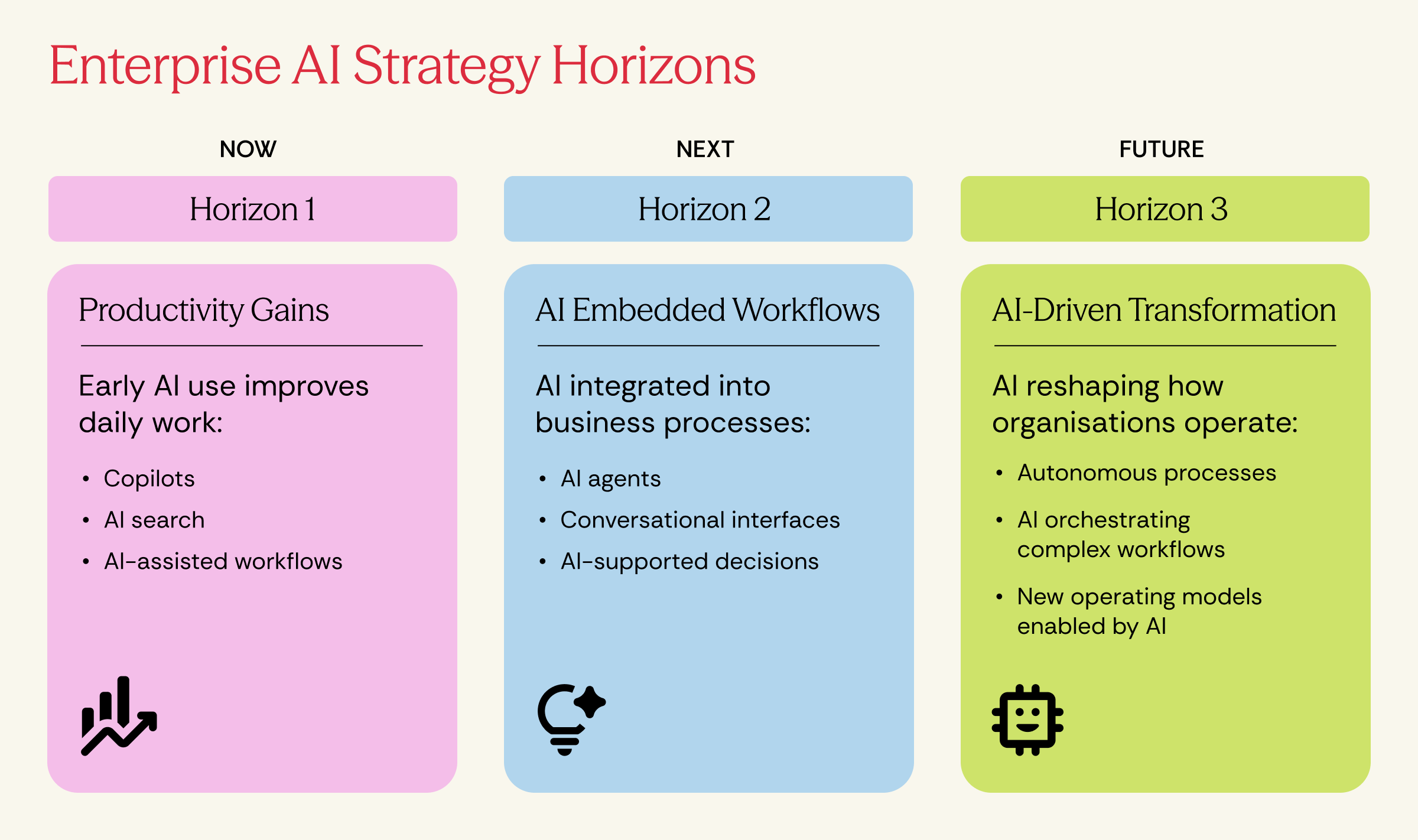
A more effective enterprise AI strategy focuses on three horizons
One helpful way to think about scaling AI is through strategic horizons. Organisations typically progress through stages as capability and confidence grow.
Centralised and Federated AI Models
In the early stages of AI adoption, many organisations benefit from a centralised approach.
A central team can establish governance standards, develop early use cases and build internal expertise.
As organisations mature, this model often evolves.
AI capability becomes more distributed across the organisation, closer to the teams where operational challenges exist. Domain experts work alongside technologists to design solutions that improve real processes.
Over time, scaling AI becomes a shared capability embedded across the organisation.
The Organisations That Will Succeed
Over the next few years, the difference between organisations that succeed with AI and those that struggle will become increasingly clear.
The organisations that scale AI successfully will not necessarily be those with the most advanced tools.
They will be the organisations that:
• Begin experimenting early in controlled environments
• Develop governance alongside innovation
• Invest in culture, skills and data readiness
• Build a flexible enterprise AI strategy that can evolve.
Waiting for the perfect technology rarely leads to progress. Organisations that begin learning today are the ones most prepared to scale AI tomorrow.
Turning AI Potential into Real Outcomes
At Crimson, we help organisations move beyond experimentation and build the foundations required for responsible AI adoption.
By combining deep sector expertise with Microsoft technologies and practical AI capability, we support organisations in developing enterprise AI strategies that deliver measurable outcomes.
AI is not about replacing people. It is about enabling organisations to serve their communities better, make smarter decisions and operate more effectively.
When approached responsibly, scaling AI becomes more than a technology initiative. It becomes a catalyst for meaningful transformation.
AI is already helping inside many organisations.
But without the right controls, it can expose data, create risk and make the wrong decisions.
Take the 5-minute AI Readiness Quiz and get your AI Readiness Score.

Read On