
Many organisations talk about predictive analytics as if it were a new frontier. In reality, it has been part of business decision-making for decades. What has changed is not whether predictive analytics works, but how organisations define and execute a predictive analytics strategy that delivers real outcomes.
In this article, Ian Bobbett, Chief Data Officer at Crimson, shares a practical perspective on predictive analytics strategy: why it continues to deliver value, where organisations commonly go wrong, and how leaders can move from retrospective insight to proactive decision-making. The discussion draws on Ian's experience across multiple sectors and focuses on what drives impact, not just impressive models.
Watch the podcast for actionable insight beyond the headline themes.
Why Predictive Analytics Strategy Maturity Still Varies Widely
Predictive analytics is not new. Machine learning and statistical modelling techniques have been used for 30–40 years across sectors such as retail, financial services, and media. In many industries, predictive analytics is deeply embedded because competition or risk management demanded it. What varies significantly is organisational maturity.
Some organisations have strong predictive analytics capabilities but struggle to activate insights at scale. Others rely heavily on historical reporting, not because predictive analytics is unavailable, but because the foundations needed to support a predictive analytics strategy are missing.
Common barriers include:
- Fragmented or poor-quality data
- No trusted "single version of the truth."
- Low data literacy across the organisation
- Cultural resistance to data-led decision-making.
When organisations cannot clearly articulate where value will come from, justifying investment in predictive analytics becomes difficult.
From Retrospective Reporting to Proactive Predictive Analytics
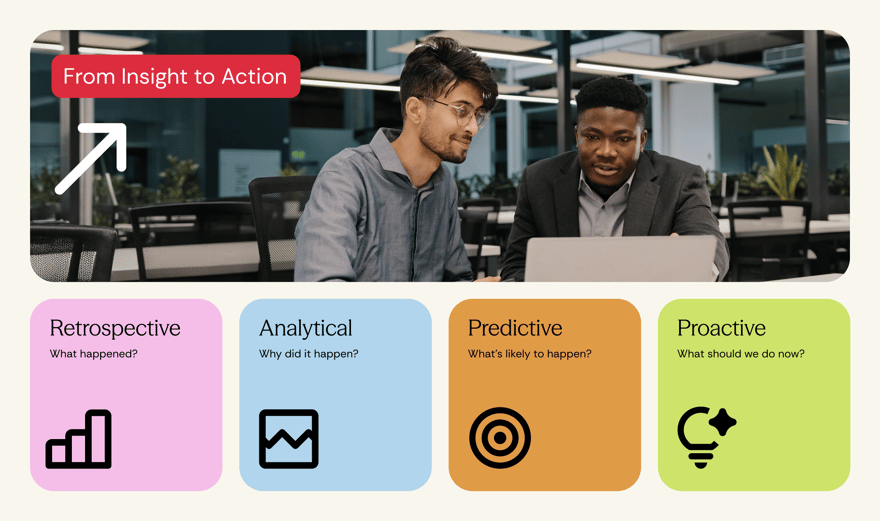
A helpful way to explain predictive analytics to non-technical leaders is to focus on decision timing, rather than algorithms.
- Retrospective analytics explains what happened and why
- Predictive analytics estimates what is likely to happen, to whom, and when
- Proactive decision-making uses those predictions to intervene early.
A strong predictive analytics strategy enables organisations to move beyond understanding past performance and towards anticipating future risk and opportunity. This allows leaders to minimise negative outcomes or maximise positive ones before they fully materialise.
In practice, organisations often reach this point organically. Once historical reporting is trusted and widely adopted, business leaders begin asking more forward-looking questions, creating natural demand for predictive analytics.
High-Value Predictive Analytics Strategy Use Cases
Predictive analytics strategy is always sector-specific, but the underlying business questions are remarkably consistent.
Across industries, predictive analytics is commonly used to:
- Grow and retain customers
- Identify future risk before it escalates
- Optimise pricing, products, and services
- Target limited resources where they will have the greatest impact.
Examples include customer retention modelling, identifying individuals at risk of disengagement, and anticipating future service demand. In many cases, relatively focused predictive analytics use cases have delivered significant financial or operational benefits when applied at scale.
The key principle is simple: predictive analytics delivers the most value when it is tied to a clear, high-impact decision.
Real World Examples: Where Predictive Analytics Has Delivered Impact
Across Ian's career, predictive analytics has been used in a range of industries to improve outcomes by identifying risk and opportunity earlier and enabling more targeted action.
In one B2B software organisation, predictive models were used to redefine how customer churn was understood. Rather than assuming customers would renew on a fixed cycle, analytics identified when organisations were most likely to re-enter a buying phase. This enabled more timely and relevant engagement, delivering significant incremental revenue within the first year.
In a broadcast media organisation, predictive analytics was applied to better understand audience characteristics using behavioural data. By improving how audience segments were classified, the organisation increased the value of its digital advertising inventory, generating substantial additional profit through more targeted advertising.
In the higher education sector, predictive analytics has been used to identify students at risk of disengagement or attrition earlier in the academic lifecycle. This allowed institutions to intervene proactively, improve retention, and direct support where it was most needed, while also protecting long-term revenue.
Similar approaches have also been applied in housing and public sector organisations, where predictive models help identify individuals at risk of arrears or vulnerability, enabling earlier, more effective intervention and better outcomes for both organisations and the people they support
Data Quality Over Model Complexity
One of the most persistent misconceptions is that predictive analytics success depends on complex models. In reality, data quality matters far more than algorithmic sophistication.
"Garbage in, garbage out" remains a fundamental truth.
Better, broader, and more consistent data will almost always deliver more value than adopting advanced modelling techniques too early. Many predictive analytics initiatives fail not because the models are flawed, but because the data feeding them is incomplete, inconsistent, or poorly understood.
A successful predictive analytics strategy prioritises data readiness before technical sophistication.
Common Predictive Analytics Strategy Mistakes
The most common reasons predictive analytics initiatives fail are organisational, not technical.
These include:
- Failing to involve end users in defining the problem
- Building models without a clear plan for activation
- Leaving insights in dashboards rather than embedding them into workflows
- Measuring success by model accuracy instead of real-world outcomes.
Predictive analytics only creates value when it changes behaviour. If insights do not influence decisions, processes, or actions, even the most accurate model will fail to deliver impact.
Embedding Predictive Analytics into Day-to-Day Decision-Making
Effective predictive analytics strategies focus on operationalisation.
In practice, predictive insights are often embedded directly into existing systems and processes, such as CRM platforms or case management tools. Predictions may be generated automatically and surfaced at the point where decisions are made, rather than requiring users to interpret standalone reports.
For example, predictive models may regularly flag individuals or cases that require early intervention, enabling teams to prioritise effort where it will make the greatest difference.
The most significant challenge here is cultural. End users must trust the insight, understand how to act on it, and see clear value in using it.
How to Build a Scalable Predictive Analytics Strategy
A predictive analytics strategy should not be approached as a single, monolithic implementation. Models need to evolve as behaviour changes, data improves, and organisations learn what works.
This is why Crimson advocates an iterative, value-led approach:
- Identify where value will come from
- Deliver one high-impact predictive use case
- Measure and validate outcomes
- Expand incrementally based on proven success.
The Crimson's Data Framework supports this by helping organisations assess potential use cases, estimate value, understand costs, and prioritise initiatives across both individual predictive solutions and wider data strategy.
The Future of Predictive Analytics Strategy
Looking ahead, predictive analytics will continue to evolve through:
- Improved algorithms
- Greater use of unstructured data
- Better integration of machine learning, automation, and AI.
The real opportunity lies not in adopting individual technologies, but in combining them to redesign how organisations operate end to end. Many organisations still have significant untapped value sitting in their data; the challenge is building the confidence, capability, and culture to unlock it.
Final Thoughts: From Insight to Impact
A well-defined predictive analytics strategy enables organisations to move beyond hindsight and make confident, forward-looking decisions. When predictive insights are embedded into everyday processes and supported by strong data foundations, organisations can consistently reduce risk, optimise performance, and improve outcomes.
Predictive analytics is not about replacing human judgment. It augments it, helping organisations act earlier, smarter, and with greater confidence.
Ready to Turn Insight into Impact?
If you're serious about building a predictive analytics strategy that delivers measurable outcomes, Crimson can help. Crimson combines deep data expertise with a structured, value-led approach to understanding data maturity, prioritising high-impact use cases, and embedding predictive insights into day-to-day decision-making.
Whether you're at an early stage or looking to better leverage existing data, Crimson helps organisations move beyond reporting and towards confident, proactive decision-making.

Read On

.jpg?width=352&name=Jigsaw%20pieces%20with%20binary%20code%20800x533%20(tinypng).jpg)