

AI Consortium
A smarter way for councils to move forward with AI
Councils are tackling many of the same questions around AI, often in isolation. The Local Government AI Consortium brings councils together to share discovery, strengthen decision-making and develop practical, reusable approaches to AI adoption.

At LGPN South, 81% of delegates identified AI as an area of interest. But our conversations revealed a harder challenge: turning that ambition into affordable, deliverable and measurable change.
After two days of conversations with local government leaders at LGPN South, one subject was impossible to avoid: AI.
The appetite was obvious. But the more we listened to delegates, the clearer it became that AI itself wasn’t really the biggest challenge. The harder question is how councils turn that ambition into affordable, deliverable and measurable change.
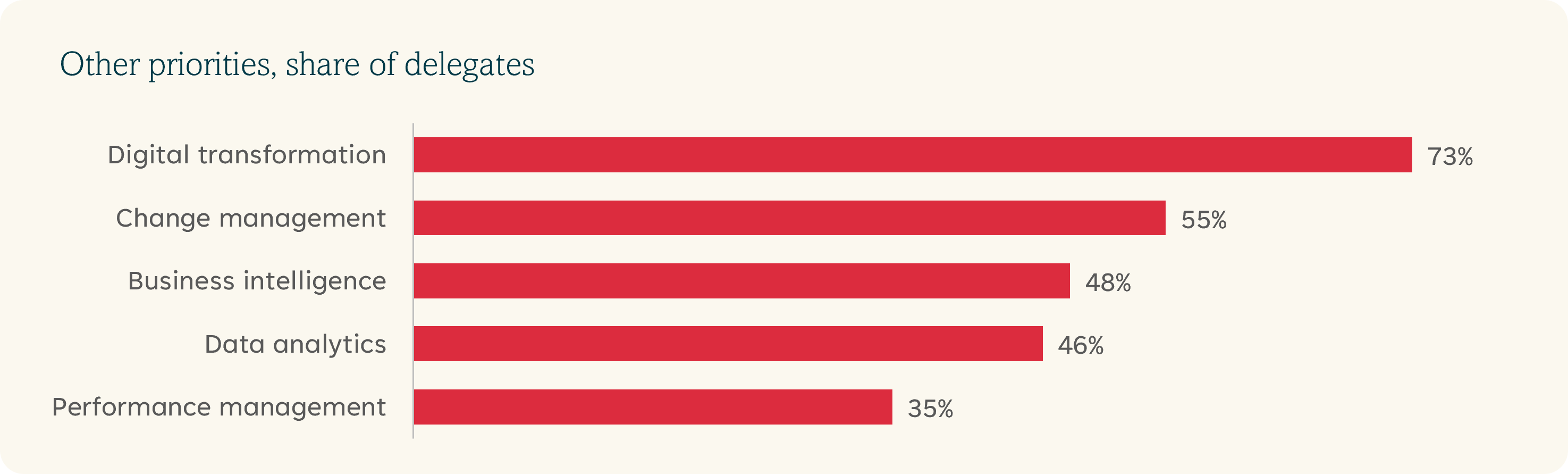
Among 163 delegates, 81% identified Artificial Intelligence as an area of interest, ahead of digital transformation at 73% and change management at 55%. Business intelligence and data analytics followed at 48% and 46%, respectively.
Those numbers tell us where attention is. What delegates said about the challenges they are facing tells a more interesting story.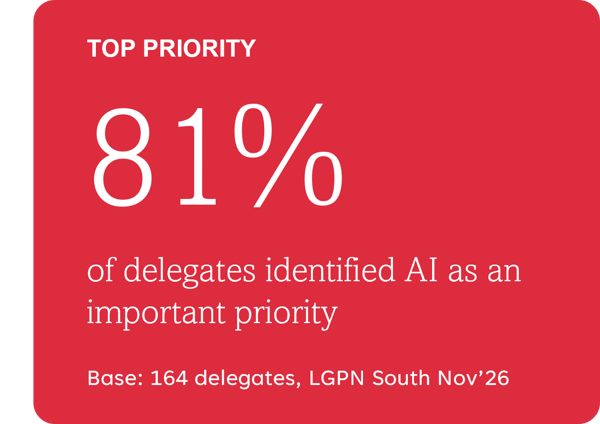
AI has attention. Now it has to deliver
The conversation around AI in local government has moved forward quickly.
At LGPN South, we heard interest in everything from Copilot and agentic AI to voice automation and potential applications across adult and children’s social care. Delegates were increasingly interested in where AI can make a meaningful difference and how councils can deploy it responsibly.
The supporting priorities received considerably less attention. Among delegates interested in AI, only 19% also selected data protection/GDPR and the same proportion selected staff training. That doesn’t measure AI readiness, but it reinforces something we heard in conversation: getting value from AI involves much more than the technology itself.
Data, governance, skills, adoption and process redesign are what turn promising use cases into sustainable change.
Every business case starts with money
If AI dominated the areas of interest, financial pressure dominated the reality behind them.
Among delegates who described the challenges they were facing, 39% raised budgets, savings or invest-to-save pressures. They talked about funding gaps, Exceptional Financial Support and the need to demonstrate a clear return from new investment. One delegate summed it up neatly: “limited money to fund innovation so needs to be a clear ROI case.”
Technical possibility is only part of the business case. Councils need to know what will actually change as a result. Will an investment reduce cost, release employee capacity, manage rising demand or improve the resident experience? And how quickly and reliably can those benefits be realised?
Delegates also talked about getting more value from technology they have already invested in, particularly within the Microsoft ecosystem, alongside concerns about supplier lock-in and rising licence costs.
The biggest priority wasn’t actually on the list
One of the most revealing findings from LGPN South wasn’t one of the topics delegates were asked to select. It was local government reorganisation.
A third of delegates who described their challenges spontaneously raised LGR. Among district council delegates, that figure rose to 71%, compared with just 4% among London borough delegates.
For councils facing reorganisation, the question isn’t simply what technology to invest in. It is what is going to make sense on vesting day and beyond.
That means making decisions now about how data, Microsoft 365 environments and core platforms such as CRM, telephony and finance will ultimately converge, while continuing to deliver essential services throughout the transition.
For councils undergoing LGR, transformation may therefore be less about adding technology and more about simplifying estates, consolidating data and systems, redesigning processes and building foundations that will work for the new organisation.
Elsewhere, the pressures are different. LGR barely appeared among London borough responses, where rising demand and financial pressure put greater emphasis on areas such as CRM, contact centres, telephony, portals, automation and self-service.
There isn’t one local government transformation agenda; what good transformation looks like depends heavily on the context a council is operating in.
AI may have dominated the conversation at LGPN South, but successful transformation depends on much more than the technology.
Three themes stood out for councils looking to turn AI ambition into practical outcomes:
01
Solve the pressure, not the technology
- Reduce avoidable contact
- Speed up service resolution
- Release employee capacity
02
Bring people with you
- 55% prioritised change management
- Build skills and confidence
- Redesign how work gets done
03
Turn ambition into outcomes
- Improve services
- Deliver sustainable savings
- Get more from existing technology
What did we take away from LGPN South?
The opportunity isn't simply to help councils adopt more AI. It's to help them identify where change will make the greatest difference and work backwards to the right combination of people, process, data and technology.
Councils also told us they value partners with relevant local government experience, demonstrable benefits and the ability to get more from technology they already own.
AI isn't the outcome. Better services, sustainable savings and greater capacity are.
Copilot readiness
Is your organisation ready for Copilot?
Our Microsoft Copilot Readiness Assessment reviews your licensing, permissions, data governance and security, then gives you a practical plan for a controlled rollout.
