In today's business environment, digital platforms no longer serve as passive enablers; they are the central means by which organisations compete, adapt and deliver value. To stay ahead, you must design them not as static systems, but as evolving ecosystems that respond to market flux, enable innovation and empower both people and intelligent agents. In this blog by Crimson's Chief Technology Officer, Oliver Sinclair, we explore three pivotal trends: composable systems, hyper-automation and AI-embedded platforms. Olly outlines how businesses can remain agile and competitive in the face of rapid change.
Watch the podcast for actionable insight beyond the headline themes.
From Monolithic to Composable Platforms
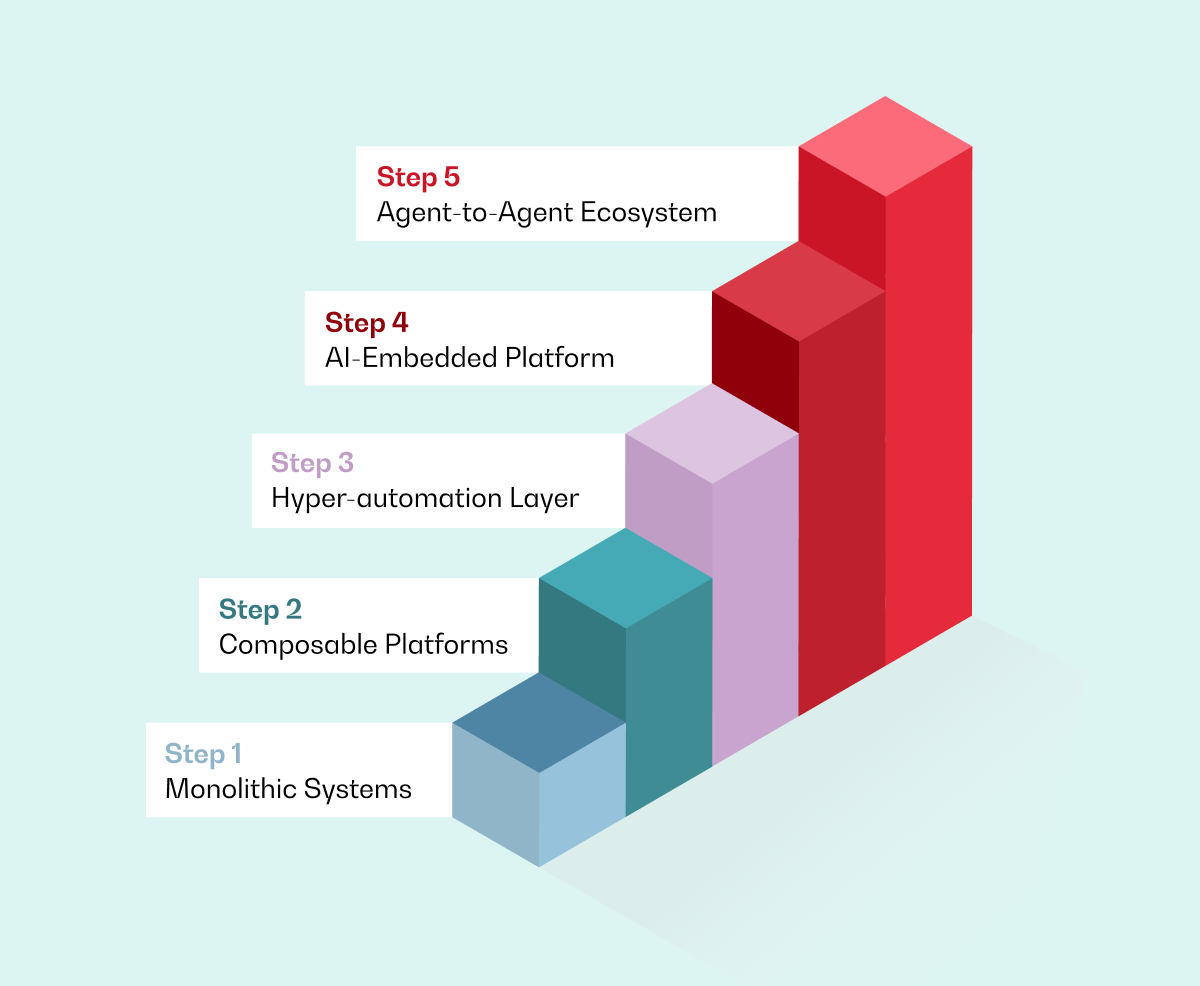
Traditional software architectures are large, monolithic, heavily customised, and can become a liability. They are costly to adapt, slow to release and brittle under change. The better path is a composable architecture, featuring modular building blocks that are loosely coupled, interoperable, and replaceable without requiring wholesale redesign. If an organisation wants to expand into new regions or industries, composable systems allow them to swap components without a complete rebuild.
By treating the platform as a living system, organisations can iterate, experiment and scale faster. For example, a retail business might deploy a new checkout component for mobile, plug-in a personalised recommendation engine, then swap in a regional tax/regulation module, all without disrupting core operations.
What this means practically
- Define a core services layer (identity, data hub, API gateway) that remains consistent.
- Build modular micro-services or "packs" that deliver domain-specific capabilities (e.g., product search, cart management, loyalty engine).
- Use patterns such as event-driven architecture, API-first design and containers/mesh to enable flexibility.
- Resist monolithic upgrades; instead, evolve via incremental waves of change.
- Ensure governance and interoperability from the outset (a loosely coupled approach still needs strong integration discipline).
Composable doesn't mean chaotic; it means structured flexibility.
Hyper-automation: Beyond RPA to Intelligent Process Orchestration
Automation has been around for decades, but the current wave is more profound and comprehensive, sometimes referred to as hyper-automation. According to Gartner, the market for software enabling hyper-automation is expected to grow at a rate of nearly 12% per year, reaching US$1 trillion by 2026.
However, more than market size, the shift lies in scope and sophistication. Hyper-automation doesn't just automate a single task or workflow; it orchestrates across multiple systems, injects AI-driven decisioning, adapts dynamically, learns, and scales. As CIO.com describes, “deep automation… emerges as a powerful weapon in the CIO's arsenal.”
Where organisations can apply it
- Automated value-chains: from order capture to billing to fulfilment, end-to-end orchestration with minimal human hand-offs.
- Dynamic exception handling: instead of static rules, AI-driven systems detect anomalies and trigger remedial or alternative flows automatically.
- Continuous improvement loops: the system monitors performance, learns from outcomes and updates workflows (via low-code/no-code platforms) to improve.
- Human-agent collaboration: employees, chatbots and AI agents working together in one workflow, not isolated islands.
For digital experience platforms (DXPs), hyper-automation means the platform doesn't simply deliver content or manage journeys, it proactively orchestrates across channels, systems and actors.
AI at the Core: Embedding Intelligence into the Platform
The next big frontier for digital platforms is embedding AI, not as an "add-on" but as a native capability. Generative and predictive capabilities are now built into enterprise DXPs; however, digital leaders should push beyond the hype to demand tangible business impact.
In other words: If the platform isn't helping your business produce measurable value (revenue lift, faster experimentation, strategic enablement), then the AI is just decoration.
Key considerations
- Human + AI design: Build workflows and interfaces that serve people but also serve autonomous agents and machines. A platform must cater to both user experience and algorithmic workflows.
- Experimentation and feedback: Embed analytics, monitoring and Machine Learning pipelines so the platform gets smarter over time, not just at launch.
- Ethics, governance and trust: AI-ready platforms demand more than performance. They require robust data governance, transparency, traceability and bias mitigation.
- Scalability and adaptability: The pace of change means the platform must support new models (agent-to-agent, multi-modal input/output) as capabilities evolve.
The digital experience space is now focused on the seamless integration of physical and digital elements.
That means mindset and architecture need to align with bodily reality: the platform is not just a website or app, but a continuously connected ecosystem.
How Businesses Can Stay Agile and Competitive
Bringing these three themes together, how can business leaders ensure the platform strategy remains resilient?
Here are the core actions:
- Establish a capability map, not a technology map. Assess your current state: what composable modules you have, what workflows are automated, and where AI is embedded. Use frameworks to map skills, architecture and ecosystem readiness.
- Prioritise outcomes over outputs. It's not about deploying the latest tech; it's about what value is delivered. For example: faster time-to-market, improved customer retention, lower operating cost.
- Invest in people and culture. The most astute CIOs are transitioning from system maintenance to ecosystem orchestration. Empower cross-functional teams (business, IT, data, automation) to operate fast, learn fast and adapt fast.
- Govern with flexibility. Establish a governance model that enables composability and change without slack, ensures standards, APIs, and data models are consistent, while allowing innovation at the edges.
- Build for continuous evolution, not one-off delivery. The platform is never “finished”. It should be designed for continuous improvement, the addition of new capabilities, and the retirement of old ones.
- Monitor and optimise relentlessly. Utilise analytics and experimentation to evaluate the effectiveness of modules, automation flows, and AI models if a piece of the platform isn't delivering value, re-compose or replace it.
The Road Ahead: Agent-to-Agent Collaboration and Platform Ecosystems
Looking forward, the platforms that will win are not simply composable and AI-embedded; they will enable agent-to-agent collaboration. That means one AI agent talking to another, executing tasks, sharing data, triggering workflows, and amplifying value without human intervention at every step.
This evolution aligns with the view of platforms as living ecosystems rather than static assets. Organisations must view their digital platforms not as a legacy to maintain, but as an adaptable foundation to build upon.
To quote a recent article by CIO.com: today's smartest CIOs "don't just run systems, they orchestrate partners to unlock growth, innovation and real business results."
Final Thoughts
In a world where technology, competition and customer expectations shift rapidly, the digital experience platform must itself be dynamic. By designing for composability, hyper-automation and embedded intelligence, organisations position themselves not just to keep up, but to lead.
As the pace of change accelerates, the winners will be those who treat the digital platform as a continuous evolution, not a one-time project. Now is the time to architect, govern and invest for adaptability, so that when the next wave arrives, you're already ready.
Read On