Digital transformation programmes rarely fail because of technology. More often, they stall due to misalignment: between business and IT, strategy and execution, or ambition and organisational readiness. These blockers can quietly undermine even the most well-funded initiatives.
In this article, Tom Cadman, Digital Transformation Director at Crimson, examines the most common obstacles organisations encounter during the digital transformation process, and the practical steps leaders can take to overcome them. From governance and funding models to culture, adoption, and executive sponsorship, Tom shares real-world insights drawn from complex transformation programmes across multiple sectors.
 Watch the podcast for actionable insight beyond the headline themes.
The Most Common Blockers in Digital Transformation
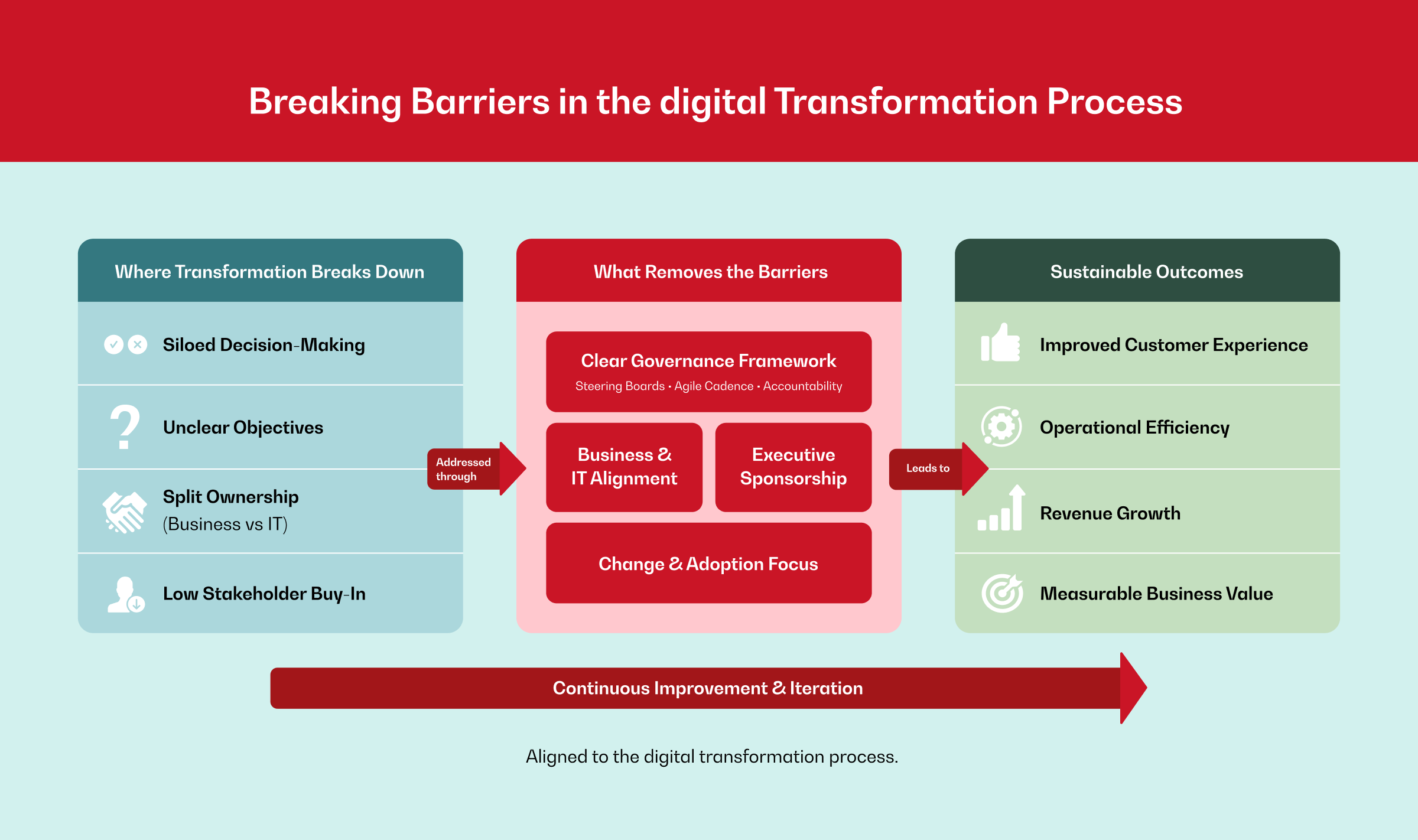
One of the most persistent challenges Tom sees is the disconnect between business and IT. Transformation initiatives are often launched without a shared understanding of objectives, ownership, or success criteria.
"The main issue is the line between business and IT, whether goals and outcomes are clearly aligned, and whether there's a proper governance framework in place."
This misalignment often shows up in very practical ways:
- Unclear ownership of budgets ("who's holding the purse strings?")
- Competing priorities between operational IT and business change
- Programmes that are labelled 'digital' but lack a clear business value case.
At their core, most transformation initiatives are driven by one (or more) of three outcomes: increasing revenue, reducing cost, or meeting regulatory requirements. When stakeholders are not aligned around which outcome matters most, progress slows, and confidence erodes.
Why These Blockers Keep Appearing
These issues persist because many organisations mobilise resources and funding in silos. Transformation may be positioned as an IT-led initiative, even when the benefits are expected to land squarely in the business.
Tom explains that alignment must happen early and explicitly:
"Any project should be clear on what it's trying to achieve. Are we driving revenue? Saving costs? Or delivering a regulatory outcome? Everybody needs to be aligned around that."
At Crimson, this is why early-stage business value assessments are critical. They help organisations articulate their desired outcomes, define measurable benefits, and create a shared foundation before delivery begins.
What Successful Digital Transformation Looks Like in Practice
There is no single metric for success. A digital transformation programme may involve portals, automation, integrations, AI, or all the above. What matters is whether those capabilities deliver meaningful outcomes.
A new portal, for example, is only successful if people actually use it.
"It comes down to understanding the end-to-end process you're trying to digitise, and whether the outcomes, for example, efficiency, revenue, customer satisfaction, are being realised."
Effective programmes define success in practical, measurable terms:
- Improved customer satisfaction or Net Promoter Scores
- Reduced processing time or operational cost
- Increased adoption of new systems and ways of working.
Crucially, these metrics must be monitored continuously, not just at go-live.
Governance: Structure Without Losing Agility
Strong governance is often misunderstood as bureaucracy. In reality, it is what enables transformation programmes to move fast without losing control.
Tom describes governance as operating at multiple levels:
- Executive steering boards aligning sponsors, delivery leads, and suppliers
- Operational cadence, such as agile ceremonies and regular checkpoints
- Clear accountability models, using RACI frameworks and transparent decision-making.
"It's still project management. You're tracking milestones, budgets, risks and issues, but in a way that supports outcomes, not just reporting."
This balance allows organisations to remain agile while ensuring progress is visible, risks are managed, and priorities remain aligned.
Aligning IT Strategy with Business Goals
One of the most challenging tasks is ensuring that the IT strategy genuinely supports the business strategy.
"The IT function exists to serve the business. You can't replace systems in isolation if the business isn't engaged."
This requires IT leaders to work closely with executive peers, building relationships and trust at board level. Increasingly, this means combining deep technical expertise with strong commercial awareness.
IT is no longer just an enabler, it is integral to how organisations operate, compete, and grow.
Executive Sponsorship and Cultural Change
Executive sponsorship plays a decisive role in overcoming transformation roadblocks. Leaders must not only approve initiatives but also actively lead them.
"Leadership is about driving from the front, aligning people to shared goals and outcomes."
At the same time, transformation cannot succeed without addressing the human side of change. New systems and processes require:
- Clear communication about why the change is happening
- Stakeholder engagement throughout the programme
- Training, drop-in sessions, and opportunities for feedback.
Adoption is one of the clearest indicators of success. If people revert to old ways of working, it's an early warning sign that something isn't working.
Technology as an Enabler, Not the Solution
As a Microsoft partner, Crimson utilises platforms such as Power Platform, Dynamics, Azure, and Microsoft 365 to rapidly bring solutions to life. These tools are powerful, particularly when combined with AI and Copilot capabilities.
However, Tom is clear:
"The technology is often the easy bit. Change adoption, hearts and minds, is still paramount."
In recent higher-education programmes, Crimson has used Microsoft technologies alongside DevOps tooling to provide full transparency across sprint boards, backlogs, and progress dashboards. This openness helps break down silos, build trust, and keep everyone aligned.
Early Warning Signs to Watch For
Transformation programmes rarely fail overnight. Warning signs usually appear early:
- Missed milestones or drifting budgets
- KPIs not tracking toward agreed outcomes
- Reduced engagement from key stakeholders
- Low adoption of new systems or processes.
"If people go rogue and revert to old ways of working, that's a signal you need to act."
Tracking both delivery metrics and human adoption indicators enables leaders to intervene early and make course corrections.
Three Priorities for Organisations Starting Their Journey
For organisations at the beginning of their digital transformation process, Tom highlights three essentials:
- Clear business goals and governance: alignment before delivery
- A realistic technology roadmap: ensuring systems are fit for purpose
- The right skills and support, including external expertise where needed.
Transformation should be broken into manageable, bite-sized initiatives, rather than treated as a single, overwhelming programme.
Final Thoughts: Breaking Barriers, Sustaining Change
A common misconception is that digital transformation is simply about upgrading technology. It is about re-examining how the business operates end-to-end and using digital capabilities to fundamentally improve it.
The scale can feel daunting, but it is also an opportunity. By focusing on alignment, governance, adoption, and continuous improvement, organisations can move beyond stalled initiatives and create lasting change.
If you're facing blockers in your own digital transformation programme, Crimson's consultants are always happy to share practical advice drawn from real-world experience.
Book a discovery call and explore how Crimson can help you overcome barriers and move forward with confidence.

Read On