Artificial intelligence is no longer something organisations are simply exploring. It is shaping decision-making, service delivery, and day-to-day operations. Once viewed primarily as a way to automate administrative tasks, AI is now influencing how organisations improve outcomes, respond to pressure, and stay competitive.
Across sectors, leaders face the same challenge: how to move beyond isolated pilots and scale AI responsibly, building confidence rather than resistance across the workforce.
Many organisations are already testing tools, exploring automation, and identifying opportunities for improvement. But experimentation alone rarely leads to meaningful adoption.
The challenge is turning early momentum into lasting change. Enterprise AI adoption requires organisations to rethink not only technology, but also leadership, culture, and how people are supported through transformation.
In this article, David Catmur-Lloyd, Consultancy Director at Crimson, explores why AI change management is fundamentally a cultural challenge, and how organisations can build the trust, leadership behaviours, and workforce engagement needed to make AI adoption stick.
AI change management starts with people, not technology
There is a persistent assumption that transformation fails because of systems, data, or complexity. In practice, those challenges are usually manageable. The harder problem is cultural.
AI introduces a deeper layer of change. It affects how people think about their role, contribution, and professional value. Employees are not just asking what AI can do, but what it means for them. Does it challenge their expertise? Reduce their autonomy? Change how they are valued within the organisation?
For many professionals, this is a fundamental shift. When AI begins to influence areas once defined by human experience and judgement, it can feel like more than change. It can feel personal.
These concerns are rarely raised directly, but they shape behaviour in real ways. Resistance often appears as hesitation, reluctance to trust outputs, or a return to familiar processes. Over time, this quietly undermines adoption, even where the technology is sound.
This is why AI change management cannot begin with tools or training alone. It must start by recognising how people experience change, by addressing concerns early, and by making it clear how AI supports individuals rather than replacing them.
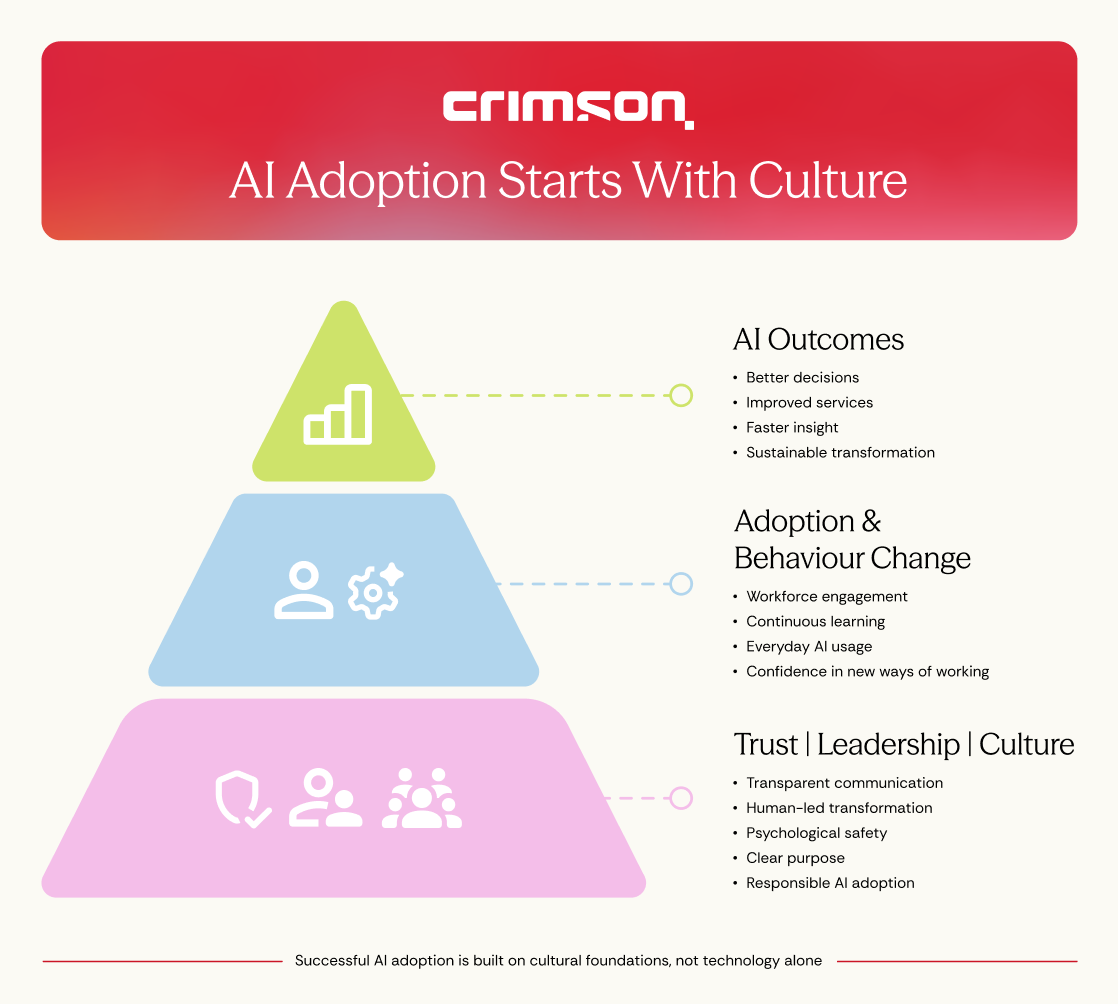
Reframing AI as a cultural transformation
Many organisations still treat AI as a technology initiative. A tool is introduced, training is delivered, and success is measured by deployment. But AI does not behave like traditional systems.
It changes how work gets done, how decisions are made, and how teams interact. These shifts go beyond process improvement. In some cases, they reshape how organisations create value.
This is why reframing AI as a cultural transformation is critical.
Organisations that succeed focus on practical adoption, starting with real-world AI applications that demonstrate value early and build confidence across teams.
These early use cases matter because they help people see how AI fits into their role. They move AI from something abstract to something tangible and useful.
In sectors such as local government, housing, and higher education, this matters even more. Done well, AI gives professionals more time to focus on what matters. Done poorly, it risks eroding trust and effectiveness.
Successful organisations position AI as a partner to human capability, not a replacement for it. It reduces manual effort, surfaces insight more quickly, and creates space for work that requires judgment and experience.
AI is not just about doing things faster. It is about enabling better decisions, improving quality, and freeing up time for what matters most.
When AI is framed this way, adoption becomes easier. When it is framed purely as a tool or efficiency exercise, resistance is almost inevitable.
Why AI culture determines success
At Crimson, we see a consistent pattern across transformation programmes. Technology enables change, but culture determines whether that change sticks.
Long-term impact does not come from delivering change once. It comes from embedding it as an ongoing capability within the organisation. The same applies to AI.
Organisations with strong AI culture share common traits. Leaders recognise AI is a learning journey, not a finished state. Teams feel safe to experiment. There is clarity of purpose, and people are involved early.
Where these conditions are missing, the same concerns often emerge: lack of trust in the technology, uncertainty about individual roles, and hesitation to move away from familiar ways of working.
These concerns shape behaviour in visible ways. Low tool adoption, reliance on workarounds, and disengagement are not technical issues. They are cultural signals.
AI culture is not created solely through messaging. It is built through leadership behaviour, team support, and whether people genuinely believe AI is there to help them do their job better, not replace them.
Building trust is the foundation
If there is one factor that determines whether AI succeeds or fails, it is trust.
Without trust, AI remains theoretical. Systems may be implemented, but they are not used. Insights may be available, but they are not acted upon.
Trust in AI is not automatic. It must be built deliberately.
That starts with transparency. People need to understand why AI is being introduced, what problems it solves, how it will be used, and where its limitations exist.
Where AI is perceived as a "black box”, confidence drops quickly. If people cannot understand or challenge outputs, they are far less likely to rely on them and are often drawn back to familiar processes.
Trust is also shaped by accountability. AI can support decision-making, but it does not remove responsibility. Reinforcing the "human in the loop" principle ensures AI is seen as a tool to support judgment, not replace it.
Trust also grows through experience. When people can test AI, question outputs, and see value in practice, confidence increases. Small, practical use cases often do more to build trust than large, complex programmes.
Leadership in the Age of AI
AI is not just changing what organisations do. It is changing how they need to be led.
Traditional leadership models built around control, certainty, and centralised expertise become harder to sustain when decisions are increasingly supported by AI. Leaders are no longer expected to have all the answers in the same way.
This shifts the role of leadership.
Instead of directing every decision, leaders need to define outcomes, clarify purpose, and enable teams to make informed choices. It becomes less about controlling work and more about creating the conditions for good decisions.
For many leaders, this requires becoming more comfortable with ambiguity, shared intelligence, and continuous learning.
Leaders also need to be open about their own learning and demonstrate how they are using AI in decision-making. This helps normalise adoption and reduces the perception that AI is separate from day-to-day work.
Just as importantly, leaders shape how safe people feel to adapt. If teams feel change is imposed or tied too closely to performance pressure, resistance will grow. If they feel supported and trusted, adoption becomes far more natural.
Leadership is not just a supporting factor in AI adoption. It is a determining one.
Workforce engagement and continuous learning
One of the biggest risks in AI adoption is treating it as something done to the workforce, rather than shaped with them.
When AI is introduced without involvement, change can feel imposed. People are expected to adopt new tools without fully understanding how or why they add value, and resistance begins to build.
Organisations that succeed involve their workforce early. They create space for teams to identify opportunities, share ideas, and shape how AI is applied in practice. This improves relevance and builds ownership.
Learning also needs to evolve. Traditional one-off training programmes are rarely sufficient for AI. The pace of change is too fast, and the practical application too varied. Learning needs to be continuous, accessible, and connected to real work.
Short, practical learning moments are often the most effective. Teams sharing how they use AI, what works, and what does not, helps others build confidence more quickly.
Over time, this creates a culture where learning becomes part of everyday work. AI adoption evolves naturally, rather than being enforced through top-down initiatives.
Measuring success beyond efficiency
AI programmes are often judged using traditional metrics such as cost reduction, productivity gains, or time saved. While important, these measures do not capture the full impact of AI.
AI is not just about doing things faster. It is about doing them better.
Success should also be measured through adoption, confidence, and the quality of decision-making. Are teams using the tools available to them? Do they trust the outputs? Are decisions being made more consistently and with greater insight?
These indicators may be less visible, but they are often more meaningful over time.
In organisations where outcomes directly affect people, the value of AI goes beyond operational efficiency. It is improved service quality, better experiences, and greater confidence in decision-making.
Organisations focused only on short-term efficiency gains may miss the opportunity to build long-term capability. Those that prioritise adoption, learning, and continuous improvement are better positioned to evolve with the technology.
Ultimately, the success of AI is not defined by what it can do, but by what organisations can do differently because of it.
AI is an imperative, but culture is the differentiator
AI is not a passing trend. It will shape how organisations operate, how decisions are made, and how value is delivered across every sector.
Organisations that delay risk falling behind. But those that move quickly without addressing culture face a different challenge: investment without adoption, and capability without impact.
Success will not be defined by access to the most advanced tools, but by creating the conditions for their effective use. That comes back to trust, leadership, and engagement.
Organisations that succeed will bring their people with them. They will build trust in how AI is applied, support teams in adapting to new ways of working, and embed a culture of continuous improvement.
Because transformation does not happen in systems. It happens in behaviours, conversations, and how organisations choose to work day to day.
If your organisation is still approaching AI through isolated pilots or technology-led initiatives, it may be time to take a different approach.
Crimson helps organisations embed AI change management approaches focused on people, culture, and long-term adoption.
Book a discovery call to explore how your organisation can move from experimentation to meaningful AI adoption and sustained value.

Read On